Download
Chitosan Hydrogel Microspheres

Preparation of chitosan hydrogel microspheres with Microdroplet/ Microsphere Generator

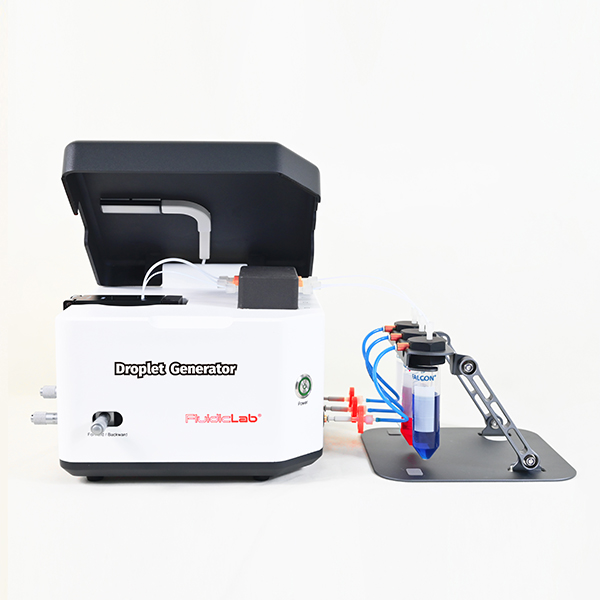
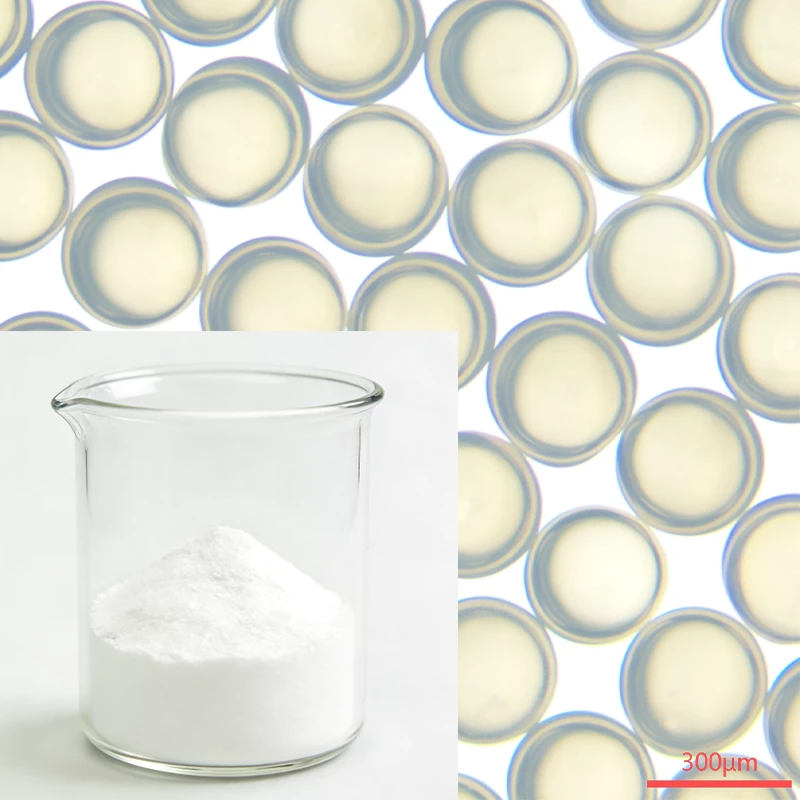
Experimental Purpose:In this application note, chitosan hydrogel microspheres with high monodispersity are prepared with FluidicLab Microdroplet /Microsphere Generator. Drop-Surf Droplet Generation Oil is used as the continuous phase and 5% chitosan is used as the dispersed phase, and the microdroplets are gelated by Schiff’s base reaction with glutaraldehyde in the cross-linking reagent solution. Finally, chitosan hydrogel microspheres with extremely high monodispersity (CV<5%) are obtained.

FEATURES & BENEFITS

Introduction

Chitosan is a functional linear polymer obtained by alkaline deacetylation of chitin [1-3]. Due to its excellent properties such as wide source, non-toxicity, low cost, biocompatibility and biodegradability, chitosan has been developed for a variety of applications. In the recent years, as a new type of functional material, chitosan has great potential application in adsorption and isolation of protein, catalytic carrier, enzyme immobilization, and controlled drug release in the form of fibers, membranes, microspheres and capsules [2]. In addition, chitosan has one primary amino and two free hydroxyl groups for each C6 unit, allowing it to react with the aldehyde group and become autofluorescent because of the n-π* transitions of the C=N bonds generated in the Schiff’s base reaction [2]. This fluorescence can be applied to blood circulation tracking, extracellular matrix characterization, in vivo cell imaging and other fields. Therefore, chitosan has a good prospect in biology, medicine, chemistry and environment.

The fine control of chitosan particle size and size distribution is of great importance for their successful application in biology, medicine and catalysis. The preparation methods of chitosan microspheres include emulsification-curing, simple coacervation, complex coacervation and membrane emulsification [2,4]. Although these techniques are adequately feasible, they have certain drawbacks, such as unstable yield, complicated procedures, non-uniform particle size with wide size distributions and lack of process repeatability. Therefore, for its successful application, it is necessary to develop a reproducible method for generating chitosan microspheres with a uniform particle size in a controllable manner.

FluidicLab provides an effective strategy for the fine control of chitosan particle size and size distribution with our Microdroplet/Microsphere Generator. This strategy has the advantages of controlling the droplet diameter, narrow size distribution (CV<5%), good sphericity with a simple and low-cost process.

ReagentsDroplet Generation Oil (Drop-Surf, 2% surfactant by weight)
Demulsifier (Drop-Surf)
Chitosan (FluidicLab)
Glacial acetic acid (Macklin, A801295-500 mL)
Glutaraldehyde (50% in water, Aladdin, G105905-500 mL)
EquipmentMicrodroplet/Microsphere Generator (Fluidiclab, 2 pressure channels)
An air compressor with an air treatment device
An optical microscope for particle size measurement
A high-speed centrifuge (Hunan Xiangyi, H1850)
A personal computer (PC, WINDOWS 7, or 10, or 11)
A standard PDMS chip holder
PDMS-FF-100 μm chips (FluidicLab)
Glass reagent bottles (10 mL, 20 mL)
Syringe tip filters (25 mm in diameter, 0.22 μm, PTFE membrane)
Syringes (10 mL)  
Centrifuge tubes (1.5 mL)
Poly (enther-ether-ketone) tubing (PEEK, 1.6 mm outer diameter) and connectors (1/4-28 UNF)
Polyurethane tubing (PU, 4 mm outer diameter, 6 mm outer diameter)  
15 mL centrifuge tubes (Falcon,15 mL, REF 352097)

1.Solution preparation:

(1)Dispersed phase: 5%(wt%) chitosan solution:
0.5 g of chitosan, 9.3 g of pure water and 0.2 g of glacial acetic acid are mixed homogeneously and heated to 85℃. After dissolved completely, filter the solution with a 0.22 μm syringe tip filter.

(2) Cross-linking reagent solution: 1% glutaraldehyde solution in oil:
10 μL of 50% glutaraldehyde solution and 490 μL of Drop-Surf Droplet Generation Oil are mixed homogeneously with vortex to obtain a 1% glutaraldehyde solution.

2. Preparation of microdroplets:

(1) Microfluidic devices set-up

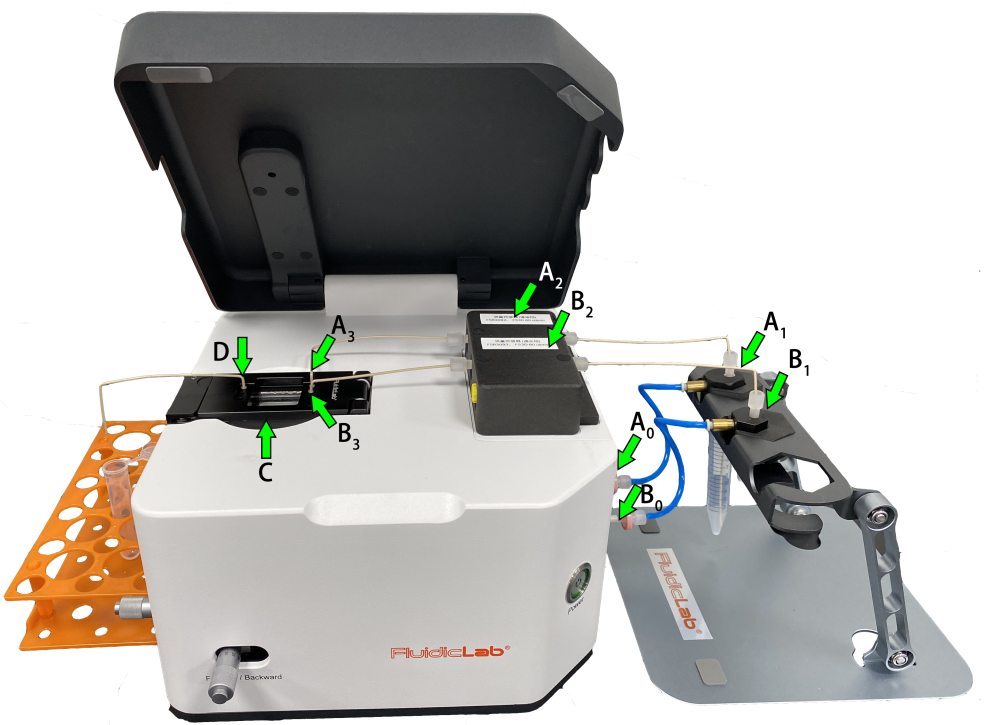
For a more detailed installation and connection of Microdroplet/Microsphere Generator, refer to the User Guide V.1.0 Of Microdroplet/Microsphere Generator, section 2. Installation and connection of Microdroplet/Microsphere Generator. The connection is as follows (steps③-⑦ are shown in the figure below):

① Connect the devices with PU tubing in the following order:

The air compressor–the air source processing device–the Microdroplet/Microsphere Generator

② Connect the device to the power supply and PC, respectively.

③ Connect A0 (the pressure channel 1 outlet) and A1 (the continuous phase reservoir), B0 (the pressure channel 2 outlet) and B1 (the dispersed phase reservoir) with PU tubing, respectively;

④ Connect A1 (the continuous phase reservoir) and A2 (the flow sensor channel 1 ), B1 (the dispersed phase reservoir) and B2 (the flow sensor channel 2) with PEEK tubing and 1/4-28 UNF, respectively;

⑤ Connect A2 (the flow sensor channel 1) and A3 (the continuous phase inlet of the PDMS chip), B2 (the flow sensor channel 2 ) and B3 (the dispersed phase inlet of the PDMS chip) with PEEK tubing and 1/4-28 UNF, respectively ;

⑥ C is a combination of a PDMS standard chip and a chip holder, which is sealed by 6 silicone connector seals;

⑦ The PEEK tubing is inserted into the chip & chip holder outlet (D) for emulsion output.

Microdroplet/ Microsphere Generator

(2) Installing FluidicLabSuite software:
Refer to the section 3.1 Installation of FluidicLabSuite Software in the User Manual V.1.0 Of Microdroplet/Microsphere Generator;

(3) Preparation of chitosan microdroplets:
For a visualized guide of this section, refer to Application Video: Preparation of Chitosan Microspheres by Microdroplets Generator.
① 5 mL of Drop-Surf Droplet Generation Oil and 1 mL of 5% chitosan aqueous phase solution are added into the corresponding reservoirs, respectively:
1.Reservoir 1 (controlled by Pressure Channel 1): Droplet Generation Oil;
2.Reservoir 2 (controlled by Pressure Channel 2): 5% chitosan aqueous phase.
② For the use of the camera and the flow sensors, refer to the section 3.2 Equipment Addition of FluidicLabSuite Software in the User Guide V.1.0 Of Microdroplet/Microsphere Generator.
③ Turn on the air compressor and air source treatment device.
④ A Centrifuge tube is placed at the emulsion outlet to collect the pre-waste liquid.
⑤ Set the pressure of pressure channel 1 and 2 by FluidicLabSuite control to exhaust the air in the PEEK tubing and the microchannels of chip.
Tips: Due to its high viscosity, we kindly suggest you set a higher pressure in the dispersed phase than in the continuous phase. For example:
Pressure Channel 1 (controlling the continuous phase): 150 mbar;
Pressure Channel 2 (controlling the dispersed phase): 900 mbar.
⑥ After the PEEK tubing and the microchannel of chip are filled with liquid, switch the control mode from pressure control to flow rate control. The flow rates of channels 1 and 2 are set as 20 and 5 μL/min, respectively.
⑦ The smooth output of target flow rate can be quickly achieved through adjusting the feedback value.
⑧ After a few minutes, collect a drop of the emulsion onto a hydrophobic substrate base, and ensure the uniformity of droplet size with an optical microscope.
⑨ After that, collect the emulsion into a 1.5 mL Centrifuge tube containing cross-linking reagent solution.
⑩ Collect the emulsion for 20 minutes, and 20 minutes of cross-linking time with gently vibration is allowed for cross-linking gelation.

3. Aftertreatments:

For a visualized guide of this section, refer to Application Video: Preparation of Chitosan Microspheres by Microdroplets Generator.

① Remove the oil phase (at the bottom of the tube) with a pipette;

② Add 2x volume of Drop-Surf Demulsifier to the microspheres. For every 100 μL microspheres, add 200 μL Drop-Surf Demulsifier.

③ Vortex the mixture for 20 seconds, then centrifuge 2000 rpm for 30 seconds. Remove the demulsifier at the bottom of the container.

④ Repeat steps ② and ③ 1~2 times. Finally, the solidified chitosan microspheres are obtained.

Tips: It is not recommended to disperse prepared chitosan hydrogel microspheres in water since the microspheres may swell and dissolve.

4. Cleaning of Microdroplets/Microsphere of Generator:

The PEEK Tubing, the flow sensors and the microchannels of the chip in the instrument should be cleaned after the experiment. Otherwise, the reagents remaining in the flow channels could possibly damage the flow sensors and clog the microchannels of the chip. For details, please refer to the Instruction Card of Microdroplet/Microsphere Generator.

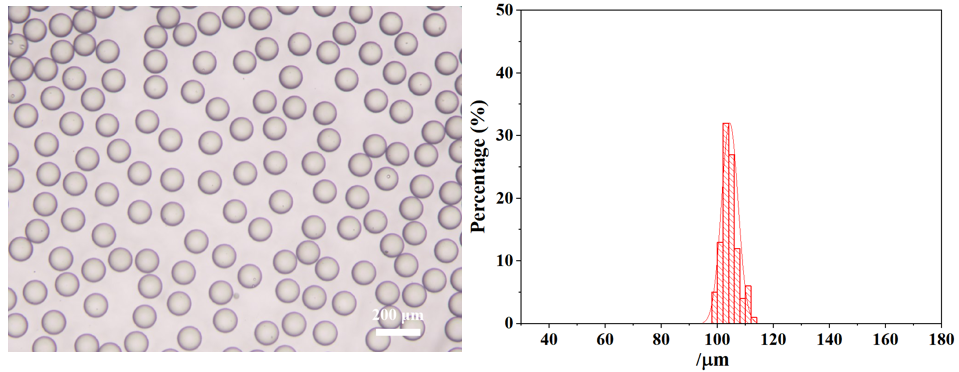
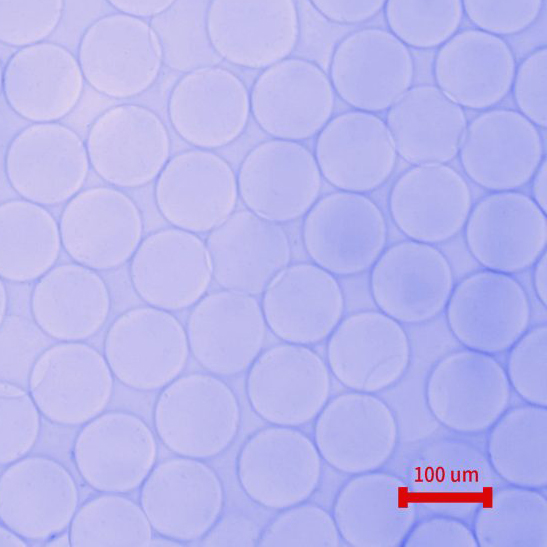
1.The average particle size of the chitosan microdroplets is 107.53 μm with extremely high monodispersity (coefficient of variation: CV=2.14%). The picture and particle size distribution are shown as follow:

Preparation of chitosan hydrogel microspheres with Microdroplet/ Microsphere Generator

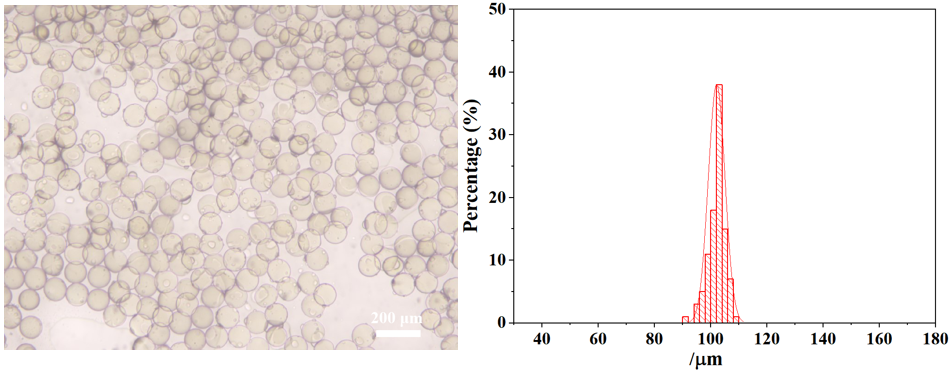
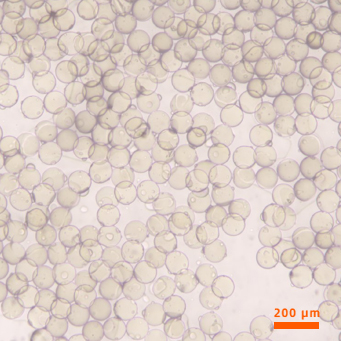
2.After cross-linking gelation, the average particle size of chitosan hydrogel microspheres is 101.67 μm, which also has extremely high monodispersity (CV=2.53%). The picture and particle size distribution are shown as follow:

Preparation of chitosan hydrogel microspheres with Microdroplet/ Microsphere Generator

Key points of the experiment

1.This application note is only suitable for the chitosan kit provided by FluidicLab. Other reagents may not be applicable.

2.The viscosity of dispersed phase is higher than that of the continuous phase, thus, the pressure of dispersed phase is higher than that of the continuous in the same flow rate. Due to its high viscosity, we kindly suggest you set a higher pressure in the dispersed phase than in the continuous phase.

3.It is not recommended to disperse prepared chitosan hydrogel microspheres in water since the microspheres may swell and dissolve.

References

[1] Zhao H., et al. A novel microfluidic approach for monodispersed chitosan microspheres with enhanced autofluorescence, Chem. Eng. J., 215–216, 784-790 (2013).

[2] Xu, J.H., et al. A Novel Microfluidic Approach for Monodispersed Chitosan Microspheres with Controllable Structures. Adv. Healthcare Mater., 1, 106-111 (2012).

[3] Zhu Y., et al. Microfluidic synthesis of thiourea modified chitosan microsphere of high specific surface area for heavy metal wastewater treatment, Chin. Chem. Lett.,28, 633-641 (2016).

[4] Xu, J.H., et al. Preparation of monodispersed chitosan microspheres and in situ encapsulation of BSA in a co-axial microfluidic device. Biomed Microdevices11, 243–249 (2009).


NEED HELP OR TECHNICAL INFORMATION?

NEED HELP OR ADVICE?

For any help to determine what microfluidic instruments you need, you can contact us! Our experts will help you build the best microfluidic setup for your application, with our state-of-the-art microfluidic line.

GET IN TOUCH

Talk to our experts
Contact Form

PRODUCTS

Fluid Control Systems
Droplet Microfluidic Systems
LNP Synthesis System
Measurement & Detection
Microfluidic Chips
Microfluidic Reagents

APPLICATION

Hydrogel Microspheres
Nanoparticles Packs
Dissolvable gel beads

INDUSTRY

OEM Products

CONTACT

  • 315, Building 1, No. 8 Memorial Road, Yangpu District, Shanghai, China
  • +86 021-65103566