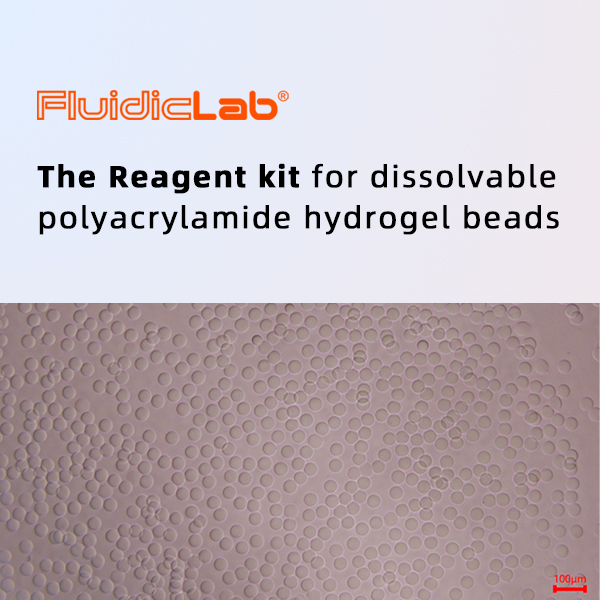
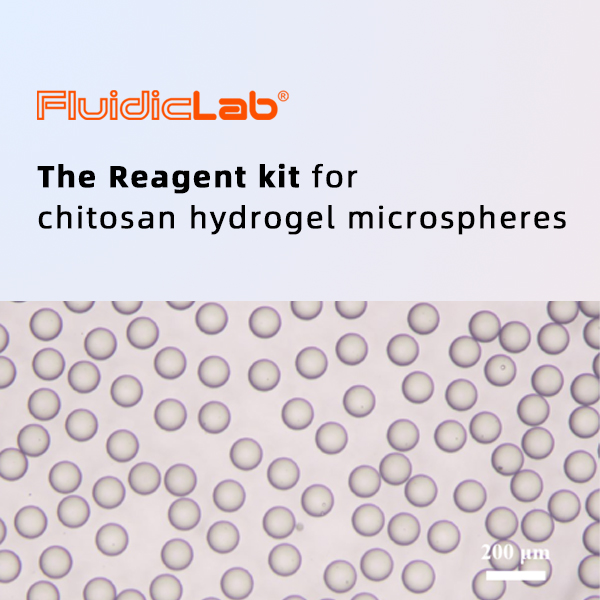
FluidicLab Reagent kit for dissolvable polyacrylamide hydrogel beads
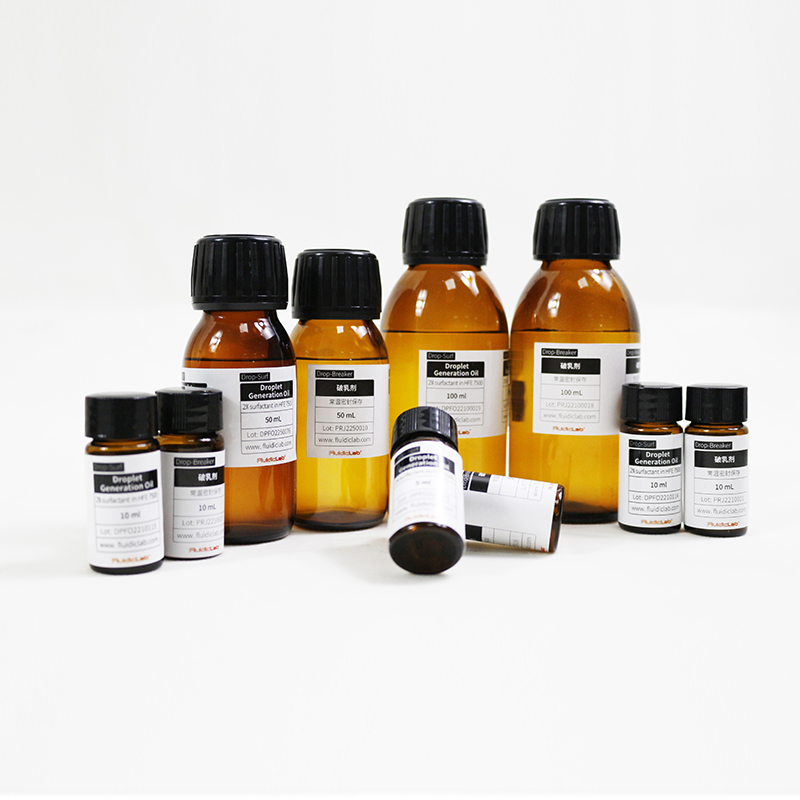
FluidicLab provides a full kit for preparation of dissolvable polyacrylamide hydrogel beads. This kit is composed of the aqueous phase (including TBSET buffer, ammonium persulfate (APS), 40% acrylamide solution (Acryl) and 0.8% N,N’-bis (acryloyl) cystamine solution (BAC)), the oil phase (including Drop-Surf Droplet Generation Oil and N,N,N’,N’-Tetramethylethylenediamine (TEMED)) and the aftertreatment reagents (including demulsifier, 1% Span 80 in n-hexane and TET buffer). DNA fragments of specific sequences can be simply added to the aqueous phase.
To reach a desired result of highly monodisperse dissolvable polyacrylamide beads (CV<5%), we strongly recommend you to use FluidicLab Microdroplet Generator and FluidicLab Microfluidic Chips (hydrophobic, with a chip holder). For further information, refer to related introductions.
The dispersed phase (containing TBSET buffer, APS, Acryl, and BAC) and the continuous phase (containing Drop-Surf Droplet Generation Oil and TEMED) are pushed into a microfluidic chip by FluidicLab Microdroplet Generator, and droplets are generated after the dispersed phases sheared by the continuous phase. Acryl monomers and BAC cross-linker can react through C=C double bonds to form a polymer bead in the presence of APS and TEMED at 65 °C overnight.
a. 10% (w/v) Ammonium persulfate (APS) solution: Dissolve 0.1 g APS in pure water for 1 mL solution.
b. The mixture of Acryl, BAC and APS solution: 200 μL of TBSET buffer, 300 μL of 40% (wt%) acryl solution, 980 μL of 0.8 % (wt%) BAC solution, 120 μL of 10 % (wt%) APS solution are mixed homogeneously with vortex, and filtered through 0.22 μm or 0.45 μm filter membrane.
c. The dispersed phase solution: 800 μL of the mixture of Acryl, BAC and APS solution, a certain concentration of primer and pure water were mixed homogeneously with vortex to obtain 1 mL dispersed phase solution.
Tips: For example, for 1 mL aqueous phase solution with 10 μM primer, when the initial concentration of primer solution is 150 μM, add 166 μL primer solution and 34 μL pure water to the aqueous phase. Components of dispersed phase are as follow (for 1 mL).
3 mL of Drop-Surf Droplet Generation Oil and 12 μL of TEMED were mixed homogeneously with vortex (Voil : VTEMED = 1000:4).
3. Fill the reservoirs with prepared solutions.
Reservoir 1 (controlled by Pressure Channel 1): continuous phase solution; Reservoir 2 (controlled by Pressure Channel 2): dispersed phase solution.
4. Preparation of dissolvable polyacrylamide beads
a.Microfluidic devices set-up Refer to instructions to Microdroplet Generator. Standard PDMS-FF-50C Chips are recommended.
b.Generation of the microdroplets. 1) The continuous phase solution and dispersed phase solution are respectively introduced into the microfluidic chip by pressure. 2) Set proper flow rates in order to reach a stable microdroplet generation. For a final result of 50 μm beads, we suggest you set the dispersed phase flow rate to 10 μL/min and set the continuous phase flow rate to 15~30 μL/min for 37~39 μm droplets. 3) The droplets are collected in a container when the droplets size in the emulsion are homogeneous.
c.Cross-linking gelation Covered the collected droplets with a proper volume of mineral oil and incubated at 65 ℃ for overnight. For a 1.5 mL or 2 mL centrifuge tube, covered the collected droplets with 200 μL mineral oil.
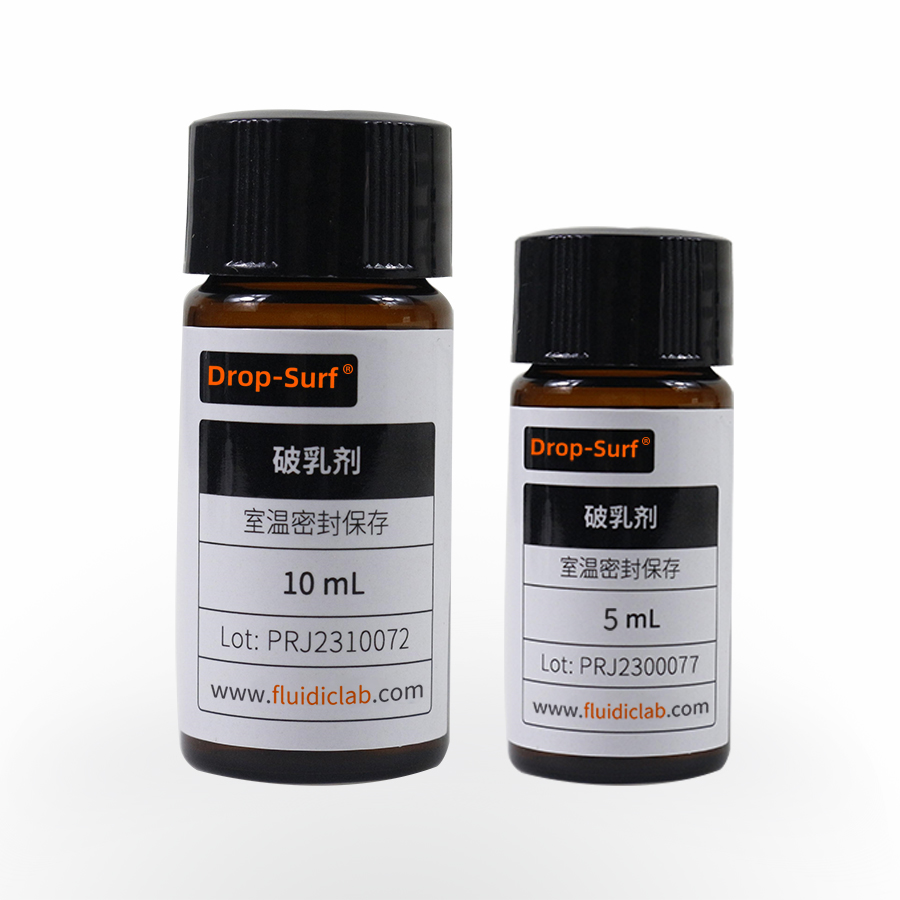
d.Aftertreatments 1) Remove the mineral oil (at the top of the container) and the oil phase (at the bottom of the container) with a pipette; 2) Add 2x volume of Drop-Surf Demulsifier to the beads. For every 100 μL beads, add 200 μL Drop-Surf Demulsifier. 3) Vortex the mixture for 20 seconds, then centrifuge 5000 rpm for 30 seconds. Remove Drop-Surf Demulsifier at the bottom of the container. 4) Repeat steps 2) and 3) 1~2 times, until all white beads on the top of the container change into transparent. 5) Add 2x volume of 1% Span 80 in n-hexane solution to the beads. For every 100 μL beads, add 200 μL 1% Span 80 in n-hexane solution. 6) Vortex the mixture for 20 seconds, then centrifuge 5000 rpm for 30 seconds. Remove n-hexane at the upper of the container. 7) Repeat steps 5) and 6) 1~2 times. 8) Add 3x volume of TET buffer to the beads. For every 100 μL beads, add 300 μL TET buffer. 9) Vortex the mixture for 20 seconds, then centrifuge 5000 rpm for 5 minutes. Remove buffer at the upper of the container. 10) Repeat steps 8) and 9) 1~2 times. 11) Finally, disperse the beads in TET buffer. The prepared beads can be stored at 4 ℃ for up to 6 months.
For any help to determine what microfluidic instruments you need, you can contact us! Our experts will help you build the best microfluidic setup for your application, with our state-of-the-art microfluidic line.